 Click image to see articleBack to basics
The longer I live the more familiar the Roman Catholic Church becomes. And this is bad news, believe you me. The challenges of Vatican II which would have made the church more relevant have been betrayed by the institution itself. The church is becoming more and more like it was under Pius XII, including the Marian delusions and all. The promise of the Holy Spirit (or Ghost as s/he was then) speaking through the people of Christ has been firmly replaced by the Papal megaphone as the one and only option for the poor bird to have (one-way) communication with its flock.
Vatican II betrayed.Only those who lived before it and through it can appreciate how much the calling of Vatican II meant. It was a cataclysmic event, in the league of the Second Coming. It brought in the vernacular to replace the witchcraft and to let the people directly understand the message and commune with the divine. It replaced the theology of "error has no rights", which was typical of the Inquisition, with one which put the human being, as God's creation, centre stage. It allowed for change. In fact, it was predicated on change. Unfortunately in his enthusiasm and admiration for John XXIII, the Lord called him home prematurely and the whole thing unravelled. Well, more accurately, it was gradually picked apart by Curial vultures and hyenas and now we're back where we started.
The Silencing of Father TonyToday's news that Fr. Tony Flannery's monthly
column in the Redemptorist magazine, Reality, has been pulled out of fear of Vatican retribution, marks a new low point in this slide into evil. Hans Kung and his ilk were silenced long ago and that was supposed to have solved the problem of dissent, or questioning as I would prefer to call it. The Vatican retreated into fortress mode and began issuing edicts to plug the perceived holes in the dyke.
 Reality
I had originally said here that I was disappointed in the Redemptorists, but I have since read of the silencing of Fr. Moloney (editor of Reality) and have also seen the courageous stand taken by Fr. Flannery's superior, Fr. Egan. So it's hat off to them.
The present turbulence has, however, led to a bit of a milk and water issue of Reality this month. The issue, which dropped Fr. Tony, is reduced to offering a rambling
piece on a second best solution to the "problem" of the ordination of women: women deacons, complete with a picture of Pam, which is not captioned, and who is not mentioned in the body of the article. At least the discerning reader is treated to an incisive but respectful critique of the new missal from
Fr. Michael Commane.
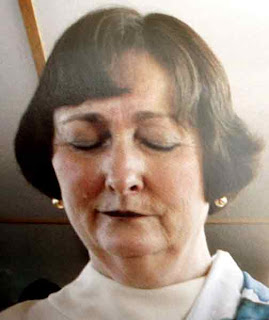
This is Pam.
She was chosen to illustrate the article in
Reality on women deacons.
The Magisterium & the Infallibility TrapPaul VI put the matter of contraception beyond dispute with Humanae Vitae (1968). Some have argued that this encyclical carried with it the stamp of infallibility, which meant it had to be true and for all time. Today the same argument is made regarding the edicts on the ordination of women of Paul VI (1976) and John Paul II (1994). These are held to be, not just part of the magisterium for the moment, but eternally infallibly true and binding.
Reverend MoThis is just plain nuts. There is not a single convincing theological reason why women should not be ordained to the priesthood in modern times. The priest is not Christ, though some of them behave like they thought they were. The priest is the agent of Christ. It is the host and not the priest that turns into the body and blood of Christ (if you believe that sort of thing - more of which anon).
Roma locuta estFortress Vatican is engaged in buckpassing and avoidance of moral responsibility on a grand scale. The shameful and abusive
letter from the Pope to the People of Ireland, in the wake of the final exposure of rampant clerical sexual abuse of children, is just unbelievable. Why are the Vatican running so scared as to become abusive in defence of their institution to the detriment of clergy and flock. One can only conclude that it is cowardice in the face of moral responsibility or a fear of losing their material wealth in massive compensation settlements. I suspect it's a bit of both. And these are the moral arbiters who are in charge. Wow.
Hallucinations and the pathology of KnockIt reminds me of Knock (Co. Mayo, that is) long before the Marian delusions of Eugenio Pacelli. Irish catholics had their own ways and devotions back then (1879) but they were not conducive to absolute obedience to Rome, so Rome rule had to be imposed. Coupled with the Church's opposition to the legitimate land agitation of the day, this confused the people and tore communities apart. The
Knock hallucinations, which were a product of this communal nervous breakdown, could not even be reported straight but had to be filtered through an orthodox Roman theology before they could be allowed see the light of day.
1984 and all thatNow it is time to brush up on your Latin: censor librorum, nihil obstat et imprimatur. Phrases that have penetrated the marrow of Pius XII catholics. Good God, they even
banned George Orwell's 1984. I once tackled the University Chaplain on that one and learned it was for its sexual content. Hadn't noticed that myself when I had read it and I pressed him (it was, of course, a him) further. "The depersonalisation of sex" said he quoting a phrase from the book that I don't have in front of me at this moment but which was supposed to be on the lines of "they went behind the bush and had it" or "did it" or whatever. Really and truly. I am sure Mr Berlusconi would die laughing or something.
Pray for usAnyway, we are now heading straight back to the devotional model of the RC church. I remember it well. We had a Patrician group in our parish. I used to do papers for the "discussion". Now this was not an ecumenical group. Perish the thought. John Charles had decreed that there should be a discussion group for catholics the better to have them understand their faith and secure obedience thereto. I remember Mrs. Whelan, God bless the woman. She had had a hard life and turned up at the discussion group as a form of attendance at devotions. When the discusson got in any way heated, she would interject with "Sure God is good". Knowing the woman's hardship and her faith, there was no follow up to that. End of discussion.
Then there was Veritas, the Catholic Truth Society, and it's still there, waiting. They made me a reader until I mentioned to them that they had enough devotional stuff on the shelves, Maria Goretti, Don Bosco, Fr. Damien, The Little Flower and so on, and that they should really be looking at debating serious issues confronting the church at the time. I never got anything else to read. Don't get me started on that crowd.
Ut omnes unum sintYou can't beat the old subjunctive when you're fudging it. I used to be a promoter of the Unity Octave way back in the days when I thought they were serious about it. But it turned out not to be ecumenism or rapprochment but
unconditional surrender. Our terms or nothing. I remember when we couldn't go to a Protestant funeral on pain of mortal sin. The same held for entering a Protestant church, whether or not there was a service in progress. And as for reading the
King James bible, the belt of a crozier was nothing compared with a thump of a Douai (annotated) in the solar plexus.
And back to the ordination of women for a moment. Are they really going out of their way to insult the worthy Deans of
Kilkenny and
Waterford. Well maybe they are but in a non-discriminatory way. They would probably denigrate the heretic
Paddy Anglican in the same breath. Or, the apostate,
Rector Jim. Amazing.
Hosts of AngelsNo, this is not a reference to the temporal power of the Papal States. Rather I am thinking of the fast approaching International Eucharistic Congress. This June will see the hosts assembling to honour the Host. But the awkward little matter of the "Real Presence" will leave our "separated brethern" out in the cold. Now that would be really bad publicity, so lets invite them in, but to a non-real-presence eucharist which we can all share. I hope they fix this up properly with Baby Jesus in advance. We wouldn't want him turning up uninvited at just the wrong moment.
Jesus needs a drinkI wonder will there be any consideration at this Eucharist Fest of the predicament of
recovering alcoholic priests, who, if they want to say mass, are obliged to do so under both species and using alcoholic wine. Another choice that should not have to be made, between celebrating the mass and sobriety. The same defective reasoning applies here as to the ordination of women priests. Christ did not ordain women and he used alcoholic wine at the last supper. Clearly the alcohol is a vital ingredient in transubstantiation, infallibly and immutably so. But what of transubstantiation itself. It is surely finally under threat from the latest advances in nuclear physics. See my
paper for the Theological Seminar.
Life after LifeAnd the afterlife? Who'd want to go to heaven to have their holy catholic soul hijacked by those awful Mormons. Would you believe the Vatican believes in this post-mortem threat to the souls of the faithful departed. They have even used it as a basis for denying family members (and professional genealogists) access to original parish records (so you have to fork out dosh to a diocesan heritage centre to push a button at €80 a twist). And you should see, in the originals of course, what they charged the poor hoors for baptising/marrying/burying them in the old days. And the vicious underlining of ILLEGITIMATE and BASTARD in some of the records. No wonder they don't want you poking around the
originals. Now, with that rant out of the way, I have to say that in recent times that has applied to only one bishop on my beat, who was happily downfaced recently by that secular institution, the admirable National Library of Ireland. But he was getting away with it since 1992 and neither his fellow bishops nor the Vatican called a halt to his gallop.
The Lord have Mercy on your SoulAnd then there are the funerals. Another money making racket and an opportunity to harness grief in the service of a fear-peddling and authoritarian clergy/hierarchy. In my day, the religious ceremonies around funerals would remind you of the sermon in Portrait of the Artist. That piece of literature put the fear of God into me for months. Well funerals used to be like that. A pleading to the lord to forgive the sins of the recently deceased, not to keep them too long in purgatory (coupled with an offer of a few indulgences for cash) and to finally let them into their eternal reward. Scare the bejaysus out of you.
In more recent times these ceremonies have tended to become a celebration of the life of the deceased with family members and friends giving short eulogies. I found this part of the ceremony very moving. Along comes the Vatican and says no more of this secular rubbish in the house of God. Out, out, out. Unless, of course, you are a celebrity of some sort and then the fawning authorities turn a blind eye.
Now, I have heard the word bollix used from the pulpit in my local church at the funeral of a friend of mine, and I did think that went a bit far. But that's RTÉ for you. Ruin it for the rest of us.
I could not finish without a mention of Father
Vincent Twomey. When he sees what is happening to those who incur the wrath of the Vatican, I'll bet he's thanking his lucky stars he funked the debate on gay adoption in the Philosoph in UCC. I'd hate to think of the agony it would have caused the Pontiff to have to rebuke his former star pupil.
And while I'm at it. The Vatican will intimidate those who question in good faith but I don't see it making any moves to shut down that rabid redtop
ALIVE which is such a disgrace to the Order of Preachers, from whose authority it appears to be completely immune.
What a confusion of Gooses and Ganders.
AmenNow, I had better wrap up or I'll blow a fuse.
I'll finish by anticipating the criticism that, if I have left the church, or it me, as the case may be, I should just
shut up about it, that I am no longer entitled to criticise it.
Sorry. I may have changed my belief but I am still left with the
baggage loaded onto me by a closed, authoritarian and venal institution, and I am as entitled to criticise it as is the Pope himself, perish the thought.

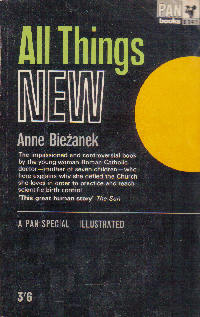


 I can now reveal the third secret of Fatima and also why it has not been properly published up to now.


